
Inspire 3 on the Coast: A Field Case Study Before
Inspire 3 on the Coast: A Field Case Study Before a Landmark Air Cinema Platform Fades Out
META: A field-based Inspire 3 case study for coastal filming in extreme temperatures, covering why its 8K full-frame X9-8K Air system, pro cinema design, and likely discontinuation matter for real-world operators.
By Dr. Lisa Wang
When a platform becomes standard kit for a certain kind of work, people assume it will stay around. That assumption is now under pressure with Inspire 3.
Recent reporting from supply-chain sources and industry insiders indicates DJI has decided to abandon the Inspire product line, with the Inspire 3 development team reportedly disbanded. If that proves fully accurate, the practical meaning is bigger than one model disappearing from a catalog. It marks a possible endpoint for a class of aircraft that sat in a very specific niche: purpose-built aerial cinema tools for crews who need far more than a consumer drone, but who also need something more integrated and deployable than a heavy custom rig.
That matters to anyone shooting coastlines in difficult weather.
I’ve used many aircraft in shoreline environments where temperature swings, wind off the water, glare, salt exposure, and remote logistics turn a simple flight plan into a production problem. The Inspire 3 made several of those problems easier to manage because it was designed first for professional image capture, not merely adapted into it later. If the reports are correct and the platform may be discontinued less than three years after its 2023 release, operators should pay attention now, not after support ecosystems thin out.
This is not nostalgia. It’s about operational planning.
Why the Inspire 3 occupied a rare position
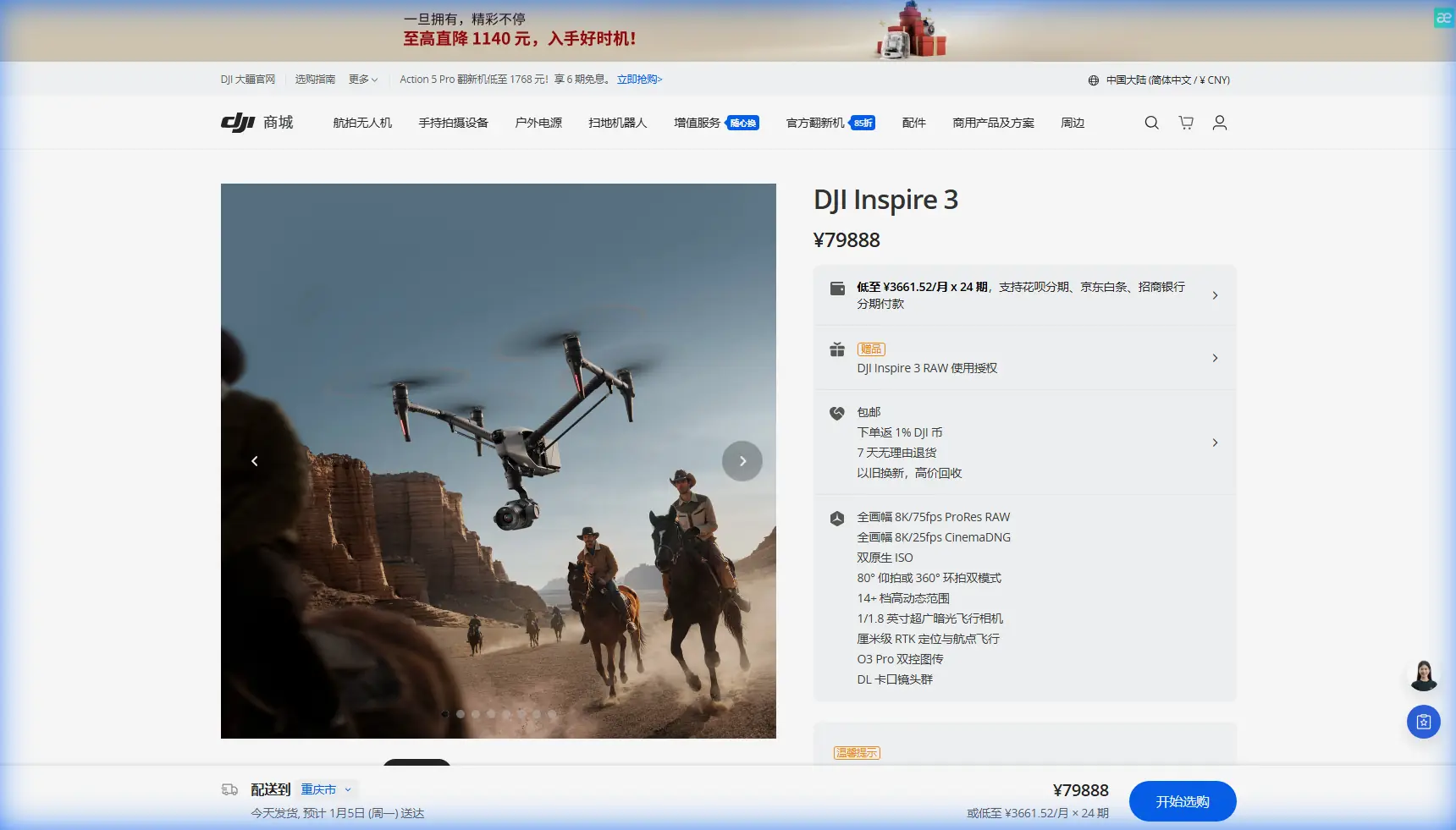
The headline specification that shaped the market conversation was simple: the Inspire 3 was presented as the world’s first integrated 8K full-frame aerial cinema platform, built around the Zenmuse X9-8K Air gimbal camera. That is not just brochure language. In field terms, “integrated” is the keyword.
For coastal productions, integration changes the day. A shoreline job often starts before sunrise, shifts across intense contrast at mid-morning, then fights haze and reflected light by noon. Every extra point of assembly, balancing, cabling, compatibility checking, or camera payload uncertainty steals time from the best light. An integrated aircraft-camera-gimbal system cuts those variables down.
The full-frame 8K capture capability also mattered beyond resolution marketing. Coastlines are visually deceptive. Wide shots need to preserve texture in waves, rock faces, wet sand, vegetation transitions, man-made structures, and atmospheric depth all at once. A platform that can hold subtle tonal information while giving editorial flexibility for reframing is not a luxury in those conditions. It’s often the difference between footage that merely documents a location and footage that actually carries a production.
The six-year gap between Inspire 2 and Inspire 3 tells you something else. DJI did not refresh this line casually. The 2023 launch followed a long interval, and the product entered the market aimed squarely at professional film and television aerial work. So if industry reports are right that there is no visible Inspire 4 project and no clear sign of a follow-on, the loss is not simply one model ending. It may signal that manufacturers see this dedicated pro cinema segment as too narrow or too difficult to justify compared with broader enterprise or creator markets.
For coastal cinematography teams, that would leave a real gap.
A coastline assignment that explains the value
One project still stands out. We were tasked with capturing a mixed shoreline: sea cliffs, a small harbor, intertidal rock shelves, and a conservation area where access windows were narrow and environmental handling had to be careful. The weather was unstable. Cold air offshore in the morning. Heat rising sharply inland by midday. Salt spray around exposed sections. We had to move quickly, protect image quality, and maintain consistent shot execution over several location hops.
Older workflows would have made this a compromise job.
On one end, smaller foldable drones can get the shot list started quickly, but the visual ceiling arrives fast when the production requires a true cinema look and grading latitude across harsh highlights and dark water detail. On the other end, larger custom systems can deliver image quality but often demand more setup discipline, more crew overhead, and more tolerance for field friction than a coastal schedule wants to allow.
The Inspire 3 landed in the middle in the best sense. It behaved like a working cinema aircraft, but still let us move.
That distinction becomes obvious when dealing with temperature swings. Batteries and airframes do not care about the production schedule. Cold mornings change performance expectations. Warmer afternoons alter them again. Coastal operators also know that “extreme temperatures” on a shoreline are not defined only by the thermometer. Wind chill at launch, sun loading on the airframe, humid salt air, and sudden transitions between open water and dark rock all change how equipment behaves and how conservatively the team needs to operate.
In those conditions, hot-swap batteries are not a convenience feature. They are a continuity tool. When your aircraft supports rapid turnarounds without forcing a complete workflow reset, you keep momentum at the exact moment the light is shifting. On shoreline jobs, those minutes are expensive in every sense except money. You lose tidal alignment. You lose wave pattern consistency. You lose cloud structure. You lose the one interval when reflections on the water are usable rather than destructive.
That is why a mature pro platform matters.
The hidden operational significance of a rumored discontinuation
The emotional reaction to a platform ending is easy to understand. The more useful question is what the news means for crews still relying on Inspire 3 today.
First, if a product launched in 2023 and may be stopped before reaching three years in market, fleet planning changes immediately. Professional teams do not buy aircraft only for current jobs. They build training routines, maintenance practices, insurance documentation, lens and media workflows, transport cases, pilot familiarity, and backup assumptions around them. A short lifecycle compresses return on operational learning.
Second, if the dedicated development team has indeed been dissolved, users should be realistic about future software evolution. Even if hardware support continues for a period, the expectation of major new capabilities or a direct next-generation transition becomes weaker. For crews doing recurring coastline work, that means now is the time to standardize settings, document known-good workflows, and secure mission-critical accessories while supply remains stable.
Third, secondary-market behavior can distort decision-making. Whenever the industry believes a respected platform is becoming scarce, attention shifts to “collectability.” That is the wrong frame for most commercial operators. The correct frame is mission fit. If your work depends on a reliable aerial cinema system with proven output and you already know the aircraft, the discontinuation rumor matters because parts availability, battery health management, and long-term support become practical concerns. If your workflow is mostly inspection, mapping, or photogrammetry, then Inspire 3 may remain an impressive but overly specialized tool.
That distinction matters. Not every good aircraft is the right aircraft.
Where Inspire 3 fits, and where it doesn’t
The Inspire 3 was built around professional aerial image making. That sounds obvious, but in today’s UAV market it is unusually specific. Many aircraft now aim to cover multiple sectors: content creation, light enterprise, inspection, mapping, public sector work, and training. The Inspire line historically resisted that flattening. It was not trying to be everything.
For coastline productions, that specialization can be a strength. If the assignment is a tourism film, resort showcase, environmental documentary, architecture sequence, marine infrastructure promo, or a branded location piece, image language matters. Camera movement matters. Lens character matters. The ability to fly repeatable cinematic paths while preserving a high-end sensor look matters.
Could the same aircraft handle selected photogrammetry support tasks? In a limited planning sense, yes. Crews often use visual flights to pre-read terrain, identify GCP placement challenges, and assess access risk before a formal survey mission. But Inspire 3 is not the machine I would lead with for precision mapping deliverables. When shoreline work shifts into engineering-grade photogrammetry, tidal-zone modeling, or infrastructure measurement, purpose-built survey platforms usually take over.
The same goes for thermal signature work. If a coastal brief includes heat-loss analysis on buildings, asset diagnostics, or search-style environmental scanning, then thermal payload platforms make more sense. Inspire 3’s value sits elsewhere: in creating the visual layer that explains place, scale, and movement with cinema-grade fidelity.
That is part of why this rumored end of line is significant. The market may still offer many very capable drones, but fewer that are this unapologetically centered on aerial cinematography.
The field workflow details that actually matter
People often reduce aircraft choices to a single spec. Resolution. Sensor size. Top speed. Transmission range. None of those are enough by themselves.
What made Inspire 3 useful on coastlines was the stack of decisions behind the spec sheet.
A platform with robust transmission behavior is not just about confidence at distance. Over water, radio behavior and visual perception become tricky. Uniform surfaces make orientation less intuitive. Glare can deceive the eye. Shoreline curvature can interrupt line-of-sight planning faster than inland crews expect. Systems associated with strong O3-class transmission performance help maintain cleaner situational awareness in demanding environments, though any crew still has to operate within local regulations and visual line-of-sight requirements unless specifically authorized otherwise. That last part is essential. BVLOS is a regulatory discussion, not a shortcut.
Security also matters more than many media crews admit. On higher-profile productions, encrypted transmission standards such as AES-256 are not abstract IT talking points. They are part of a broader data-protection chain, especially when location confidentiality or unreleased production material is involved. If you are filming a sensitive hospitality property, private development, or embargoed tourism campaign, secure links are operationally relevant.
Then there is crew continuity. Coastal jobs often involve moving between launch points with little room for mistakes. Every aircraft has a personality. The Inspire 3’s personality was “cinema machine that still respects set tempo.” That matters because fatigue accumulates fast near water. Wind noise is constant. Salt demands discipline. Sun exposure shortens concentration. A system that reduces setup friction protects not just efficiency, but judgment.
If you are still planning around Inspire 3, act like a fleet manager
Assuming the discontinuation reports continue to hold up, my advice is straightforward.
Audit batteries. Not casually. Build a real health log and remove guesswork from coastal deployments where temperature stress can magnify small power issues.
Standardize your capture profiles and exposure practices now. If this platform is going to remain in your ecosystem for years without a visible successor, your own documentation becomes more valuable than waiting for future updates.
Secure the supporting pieces that fail quietly: storage media, props, transport protection, charging routines, and any site-specific checklists tied to shoreline work.
Most of all, decide whether Inspire 3 is central to your operation or simply admired from a distance. The wrong response to discontinuation rumors is panic. The right response is clarity.
If your business is built around premium aerial cinematography, the Inspire 3 remains relevant because its core proposition has not suddenly become weaker. The X9-8K Air did not stop being a serious camera because a supply-chain report appeared. The aircraft did not lose its place in cinema workflows because there is no visible Inspire 4 yet. But if you need a flexible enterprise platform first and a cinema aircraft second, then this news may simply confirm that your future should be somewhere else.
The broader meaning of the Inspire 3 moment
Products come and go. Categories disappear more quietly.
The reporting around Inspire 3 suggests we may be watching the sunset of a distinct idea: the dedicated, integrated, upper-tier aerial cinema platform built for crews who want high-end image quality without stepping into the complexity of bespoke heavy-lift operations. That is why people in the professional filming world are reacting strongly. They are not just talking about one drone. They are reacting to the possible end of a workflow philosophy.
For coastline work in extreme temperatures, I understand the reaction. I’ve seen what happens when a platform lets a crew stay light on its feet without sacrificing the image. I’ve also seen how quickly those advantages vanish when you replace a specialized tool with something merely “good enough.”
If you are planning long-term around this aircraft and want to compare deployment strategies, battery management, or support options for coastal operations, you can message our field team here.
The Inspire 3 may be nearing the end of its production run. That does not reduce what it represented. If anything, it sharpens the picture. In less than three years on the market, and after arriving six years after Inspire 2, it established itself as a serious aerial cinema tool with a very specific strength: it made difficult, high-expectation shoots feel more manageable than they had any right to be.
That is a rare achievement in this industry.
Ready for your own Inspire 3? Contact our team for expert consultation.