
Inspire 3 for Remote Wildlife Capture: What Actually
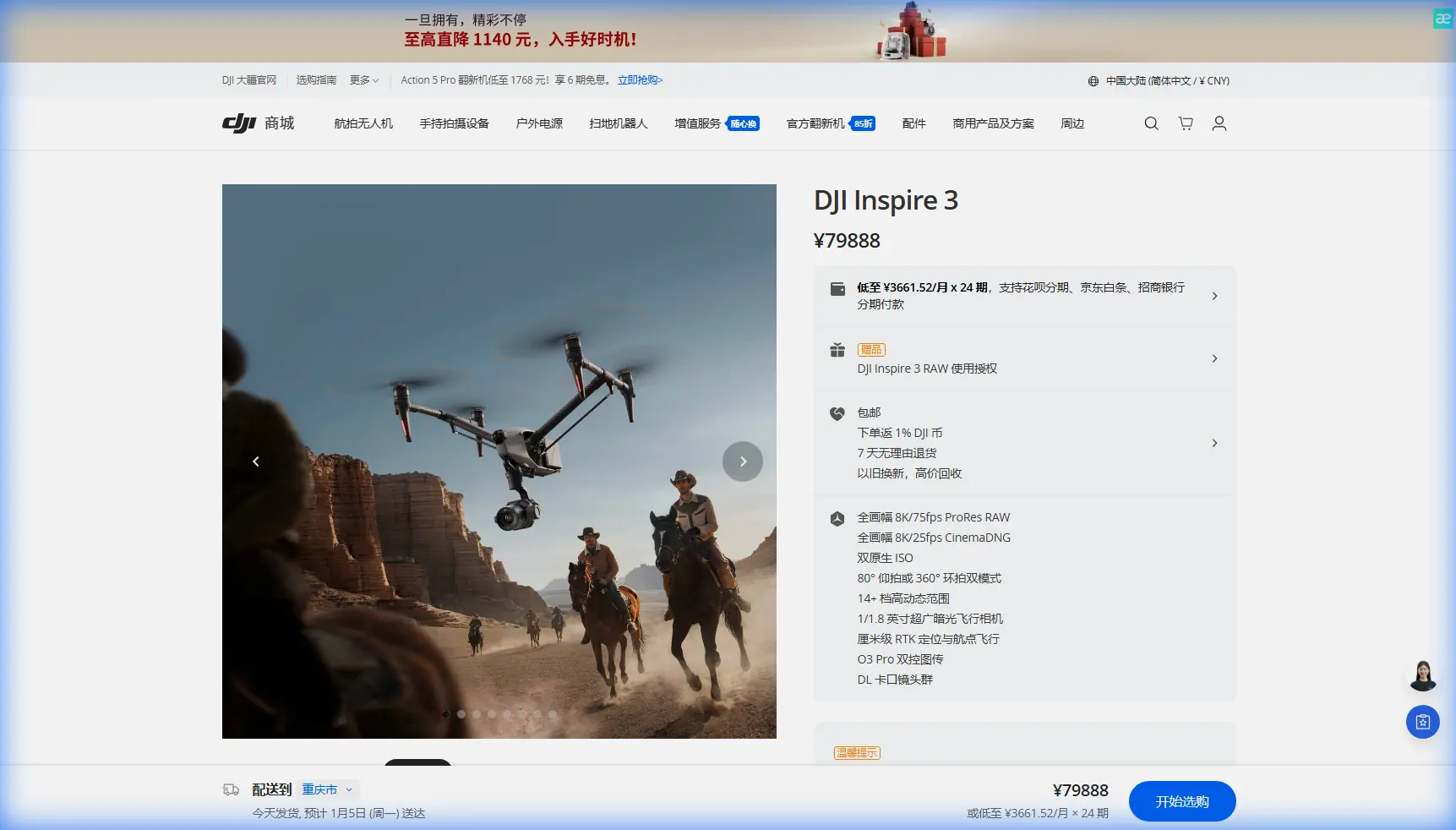
Inspire 3 for Remote Wildlife Capture: What Actually Matters in the Field
META: A technical review of using Inspire 3 for remote wildlife filming, with practical insight on battery handling, logistics planning, transmission resilience, and why aerospace-style support discipline matters.
Remote wildlife work exposes every weak habit a drone crew has.
The aircraft is rarely the only challenge. Distance, weather shifts, battery turnover, card discipline, line-of-sight interruptions, and the simple fact that animals do not wait for your checklist all push a system harder than a controlled set ever will. That is why the most useful way to think about the Inspire 3 is not as an isolated flying camera, but as a field platform whose success depends on support design as much as flight performance.
That may sound abstract until you have to launch before dawn from a rough camp, cycle multiple batteries in cold air, maintain stable video links over broken terrain, and come back with footage that is both beautiful and operationally repeatable.
I’ve seen crews obsess over lenses and frame rates while neglecting the support architecture around the aircraft. In remote wildlife production, that is backwards.
The overlooked lesson: aerospace logistics thinking applies to the Inspire 3
One of the most interesting reference points here comes from a Chinese aircraft design handbook discussing integrated support planning. Its core message is simple but sharp: support work cannot be improvised after the platform is built. The operator and manufacturer-side team must define inputs, outputs, responsibilities, timing, and maintainability targets early, then review and adjust them in a coordinated way rather than letting either side make unilateral changes.
That principle transfers surprisingly well to Inspire 3 operations in remote habitats.
For a wildlife crew, the “manufacturer and purchaser coordination” language maps neatly onto your own field reality: pilot, camera operator, data wrangler, producer, battery tech, and fixer all create dependencies. If one person changes the day’s operating pattern without aligning the rest of the team, small inefficiencies become missed animal behavior.
The handbook also describes three major support pillars: supervision and control, planning of support elements, and testing and evaluation. Those three categories are exactly how serious Inspire 3 teams should structure remote shoots.
- Supervision and control means battery tracking, media chain-of-custody, firmware consistency, airframe inspections, and flight-risk gates.
- Planning support elements means power, transport, charging rotation, spare props, landing zone discipline, and transmission contingencies.
- Testing and evaluation means proving your workflow before the decisive wildlife window opens.
That is not paperwork for its own sake. It is how you turn the Inspire 3 from a high-end drone into a dependable capture system.
Why support discipline matters more when wildlife is the subject
Wildlife subjects are not collaborative. You do not get resets. If a herd crosses a river at first light, or a raptor uses one thermal corridor for a few minutes, your success depends on readiness. This is where maintainability targets and threshold thinking become practical, not theoretical.
The same aircraft support reference stresses setting initial readiness and supportability goals, along with threshold values, and doing so early enough that they can shape the program. For an Inspire 3 wildlife team, that means deciding in advance what “ready” actually means.
For example:
- Minimum number of flight-ready battery pairs before departure
- Maximum acceptable turnaround time between sorties
- Required transmission confidence for operations in broken terrain
- Maximum allowable delay from landing to data verification
- Trigger point for suspending flights due to temperature, wind, or signal degradation
Most crews keep these in their heads. The problem is that memory gets fuzzy at 4:30 a.m. in the cold.
Remote wildlife work rewards crews that convert assumptions into thresholds. If your team knows that a battery set below a specific temperature will not be launched until it is conditioned, or that a transmission route with repeated dropouts is retired after one test flight, then the aircraft spends more time gathering usable imagery and less time gambling.
A battery management tip from field experience
If I had to give one field tip for Inspire 3 remote work, it would be this: manage batteries as a temperature-and-sequence system, not as a pile of charged packs.
People often focus on state of charge alone. In wildlife environments, especially pre-dawn or high-altitude locations, that is incomplete. A battery can be technically full and still underperform if it has soaked in cold air or if your rotation order is sloppy.
My preferred discipline is simple:
- Divide batteries into clearly marked flight groups.
- Track not just charge level, but time since removal from heat or charger.
- Assign one crew member sole authority over release-to-flight.
- Never mix partially cycled packs back into the “ready” pool.
- After landing, log aircraft behavior while the flight is still fresh.
That last point matters. If one pair shows unusual voltage sag, slightly slower response, or a noticeable drop in expected reserve during a climb-out, isolate it immediately and monitor the next cycle. Wildlife assignments punish denial. The shot you miss on the second sortie often starts with a battery clue you ignored on the first.
This is where the support-handbook mindset becomes useful again. It talks about defining who provides what input, in what form, and when the output must be delivered. In field terms, the battery tech’s “input” is not merely charged packs. It is verified, temperature-managed, rotation-controlled flight energy delivered at the right moment for the mission profile. That is a higher standard, and it is the one remote Inspire 3 crews should adopt.
Hot-swap batteries help a lot, of course. They reduce turnaround friction and preserve momentum when wildlife movement is active. But hot-swap capability is only an advantage if your battery chain is organized well enough to exploit it.
Transmission is not just convenience; it shapes animal-safe operations
The Inspire 3 conversation often circles around image quality, but in remote wildlife work, transmission reliability deserves equal attention. O3 transmission, paired with disciplined antenna placement and route planning, can determine whether you fly smoothly around terrain or waste precious minutes fighting inconsistent signal paths.
This is not only about pilot comfort. Stable situational awareness supports quieter, cleaner operations around sensitive species. A crew that can hold dependable control and video feedback is less likely to make abrupt repositioning decisions or noisy repeated passes because the first one was compromised by poor link confidence.
If your production includes georeferenced habitat documentation, route repetition, or photogrammetry passes tied to GCP placement, transmission consistency becomes even more valuable. Wildlife projects increasingly blend cinematic capture with ecological mapping, and that means flights may need to be both visually elegant and spatially repeatable.
In that hybrid role, Inspire 3 can be more than a camera platform. It can support image collection strategies where composition and terrain data inform each other. But only if the crew treats the transmission link as an engineered resource rather than an assumed feature.
For teams working with sensitive location data, AES-256 also has obvious relevance. Wildlife filming can involve nesting sites, migration corridors, or private conservation land where minimizing unnecessary data exposure matters. Security in this context is not dramatic; it is professional stewardship.
Materials science offers a useful warning for field handling habits
The second reference document, a materials handbook focused on stainless steels, might seem disconnected from Inspire 3 wildlife work at first glance. It is not.
The document repeatedly warns that certain steels lose plasticity and toughness if held within specific temperature bands. One example flags a 750–850°C interval where harmful phase changes can occur, and another notes that some alloys should avoid 350–550°C or 400–580°C tempering ranges because mechanical properties suffer. It even specifies a case where nitrogen content should be controlled below 0.1% to avoid reduced strength.
No, your Inspire 3 is not operating in those furnace conditions. But the operational lesson is directly relevant: materials have temperature-dependent behavior, and abuse often accumulates invisibly before failure becomes obvious.
That matters in the field because remote crews are rougher on equipment than they think. Cases bake in vehicles. Hardware sits in direct sun. Batteries are warmed unevenly. Fast turnarounds encourage people to skip cool-down logic. Carbon, metals, seals, contacts, and storage media all age according to thermal history, not just hours flown.
The materials reference is a reminder that durability is not a vague quality. It is conditional. Mechanical integrity depends on respecting environmental limits and post-process recovery steps. In drone practice, that translates into letting components stabilize, avoiding heat-soak cycles where possible, and not treating “still working” as the same thing as “still healthy.”
I have watched excellent wildlife crews become careless after a strong first day. Aircraft back in the case while still warm. Batteries charging in a sunlit tent. Media drives stacked without airflow. Nothing failed immediately. Then day three brought odd behavior, longer prep, and creeping uncertainty. The damage was procedural before it was technical.
Testing before the window opens
Another strong point from the aircraft support text is that review and adjustment should happen through joint evaluation, not ad hoc edits by one party. For a wildlife team, the equivalent is resisting the urge to rewrite procedures in the middle of a critical capture period unless the whole crew understands the consequences.
That is especially true when integrating a mixed workflow: cinematic tracking, thermal signature observation from companion systems if used in the broader project, mapping references, and difficult launch-recovery logistics. Each change propagates.
A lens swap can alter balance and prep time. A new launch point can reshape your O3 path. A revised schedule can disrupt battery temperature conditioning. A different offload rhythm can delay clip verification.
The answer is not rigidity. It is controlled adaptation.
Before the key wildlife window, run a full mission rehearsal. Not a half-test. A complete one. Time the setup. Measure battery turnaround. Confirm monitor visibility. Test transmission over representative terrain. Verify data handling. If GCP-supported mapping or photogrammetric reference work is part of the assignment, test that flow too. The field is a terrible place to discover that your elegant plan breaks at the handoff between departments.
Inspire 3 is strongest when the crew behaves like a system
This is the real technical review.
The Inspire 3 is a highly capable aircraft for remote wildlife capture, but capability alone does not produce reliable outcomes. The crews that get the best results are rarely the ones talking the most about specs. They are the ones who understand supportability in the old aerospace sense: define responsibilities early, establish thresholds, test workflows, and do not let critical procedures drift casually.
That is why the reference material matters. One source emphasizes coordinated support planning, formal review, and protection against uncontrolled changes to the support program. The other is a blunt lesson in how material behavior can degrade when temperature exposure is mishandled. Taken together, they point to a practical truth for Inspire 3 users: field success comes from respecting the hidden engineering around the flight, not just the visible flying itself.
For remote wildlife work, that means:
- Build a battery rotation system, not just a charging table.
- Treat O3 transmission planning as part of the shot design.
- Protect equipment from cumulative thermal abuse.
- Use threshold-based readiness checks.
- Rehearse the entire workflow before animal activity peaks.
If you want help planning an Inspire 3 wildlife workflow around your terrain, schedule, or battery strategy, you can message our field team directly here.
The crews that return with exceptional footage are not simply better pilots. They are better operators. There is a difference, and the Inspire 3 reveals it quickly when the landscape is remote and the subject does not wait.
Ready for your own Inspire 3? Contact our team for expert consultation.