
Filming Solar Farms with Inspire 3 in Extreme Heat
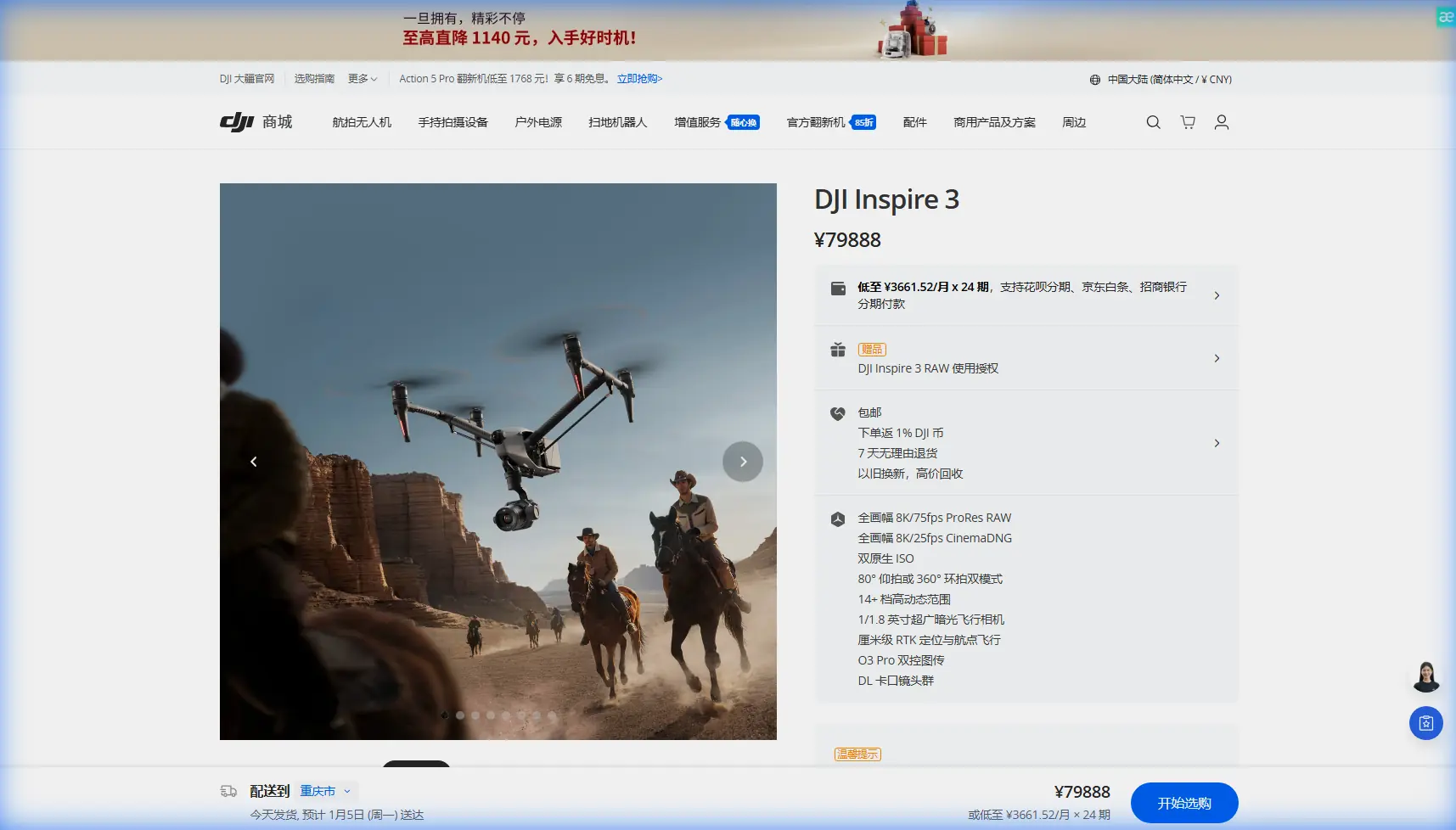
Filming Solar Farms with Inspire 3 in Extreme Heat: A Field Report from the Edge of Stability
META: A field report on using the DJI Inspire 3 for solar farm filming in extreme temperatures, with practical notes on thermal conditions, O3 transmission, hot-swap battery workflow, AES-256 security, and flight-planning discipline.
I have spent enough time on utility-scale solar sites to know that the drone is rarely the hardest part. The harder part is preserving consistency when the air is shimmering, the ground is radiating heat back into the aircraft, and the client wants cinematic footage, inspection-grade coverage, and a clean operational record in the same flight window.
That is where the Inspire 3 becomes interesting.
Not because it solves everything. It does not. But in solar farm work—especially across large arrays in punishing temperatures—it gives you a platform that can be managed like a serious aerial tool rather than treated like a delicate camera toy. This field report is built around that reality: how Inspire 3 performs when the assignment is not glamorous, the weather is hostile, and the job demands discipline.
I am writing from the perspective of someone who thinks about aircraft systems first and imagery second. That mindset matters on solar sites. Long, repetitive rows of panels create visual monotony for the eye but complexity for the aircraft operator. Heat plumes distort perception. Reflective surfaces can trick exposure decisions. Repeated passes increase fatigue. If you are also collecting photogrammetry reference or aligning footage to asset records, the need for stable and repeatable flight behavior becomes non-negotiable.
Why solar farms are harder than they look
From a distance, a solar farm seems simple: flat terrain, open sky, predictable rows. In practice, these environments are aerodynamically and operationally messy.
First, temperature. On extreme days, surface heat rising off the panel field can create localized turbulence and visible atmospheric distortion. That affects not just image quality but pilot judgment. It is one thing to fly in hot weather. It is another to fly low over thousands of heat-soaked modules while trying to hold smooth lateral movement for a reveal shot or maintain overlap for mapping.
Second, scale. A utility site can demand multiple launch points or long transits across repetitive geometry. Any weakness in transmission reliability, battery management, or crew coordination becomes obvious very quickly.
Third, data sensitivity. Many operators forget this, but infrastructure clients care about security. Layouts, fault areas, maintenance patterns, and expansion zones may not be classified in any dramatic sense, yet they are operationally sensitive. A platform with AES-256 transmission encryption is not a marketing footnote here. It matters because footage from an energy site is often more than a pretty flyover. It is a working asset record.
The Inspire 3 fits this environment best when flown as part of a system: planned route logic, battery rotation discipline, thermal awareness, and careful radio management.
The lesson from full-scale aircraft design still applies
One of the most useful mental models for operating the Inspire 3 on hot industrial sites comes from conventional aircraft design, not drone marketing. In the civil aircraft design handbook referenced here, Chapter 7 is dedicated to “weight and balance,” and the cited page places it at page 247. That might sound distant from a filmmaking drone, but the principle transfers directly.
Weight and balance is not just an engineering chapter title. It is a field discipline.
On the Inspire 3, every configuration choice changes the aircraft’s behavior in small but meaningful ways: lens selection, third-party mounts, sunshades, storage media, and any accessory that alters airflow or center-of-mass. In extreme heat, those small changes become less forgiving because battery efficiency and cooling margins are already under pressure.
I have seen crews build a brilliant shot package on paper and then wonder why handling feels less settled in the afternoon. Often the answer is simple. They have added enough to the aircraft, or changed enough about the setup, that the drone is no longer operating with the same reserve smoothness they felt at sunrise. Full-scale aviation solved this problem long ago by treating loading as a core design variable. Drone crews should do the same.
That is why my solar workflow with Inspire 3 starts with a stripped decision tree:
- What is the minimum airborne package needed for the mission?
- Which shots truly require low-altitude dynamic movement?
- Which sections can be captured through higher, more efficient passes?
- What payload changes will force a fresh flight check rather than an assumption?
This sounds conservative. It is also how you avoid wasting the only calm thermal window of the day.
Stability is not only about hovering still
The second aviation reference is from an aerodynamic design handbook that includes sections on maneuvering, mode characteristics, and sudden changes in speed and altitude. One cited section discusses the effect of “speed and altitude 급剧变化” on longitudinal behavior, indexed at page 823 in the extract. Another deals with “mode characteristics” in Chapter 24, with longitudinal modes beginning around page 792.
Again, this is highly relevant to the Inspire 3 on solar jobs.
Why? Because many pilots judge stability in a superficial way. If the drone hovers well and the gimbal looks good, they assume the platform is stable. But solar work exposes transitional stability: what happens during acceleration into a tracking pass, what happens when you arrest speed near inverter blocks, what the aircraft feels like climbing out of a hot low-level run into cleaner air, and how repeatable the response remains after several battery cycles in high ambient temperatures.
That is where Inspire 3 earns respect. Not because it defies aerodynamics, but because its behavior is predictable enough to build process around. Predictability is what allows an experienced pilot to preserve shot continuity across several sorties.
On one recent solar assignment, we had to alternate between cinematic perimeter runs and structured coverage over maintenance corridors. The useful metric was not top speed. It was how consistently the aircraft transitioned between movement states without introducing uneven gimbal workload or forcing the pilot into exaggerated correction inputs. In harsh heat, “smooth” is really another word for “thermally and aerodynamically well-managed.”
O3 transmission matters more on infrastructure sites
A solar farm can be visually open yet operationally deceptive. Repetitive panel geometry reduces depth cues. Service roads create false confidence about line-of-sight. Electrical equipment blocks can interrupt ideal positioning for the crew. This is where O3 transmission becomes more than a spec-sheet reference.
A reliable link helps in two specific ways.
First, it preserves confidence during long lateral traverses over repetitive terrain. If you lose trust in your downlink, your inputs become defensive. Defensive piloting produces worse footage and often less safe spacing.
Second, it supports cleaner role separation between pilot and camera operator. On a serious solar shoot, one person should be thinking about aircraft placement and thermal margins while the other thinks about composition, glare management, and story. A weak or unstable feed collapses that separation. Everyone starts solving the same problem, badly.
When clients ask why an Inspire 3 workflow feels more controlled than smaller-platform improvisation, this is part of the answer. Transmission integrity changes crew behavior.
Security is not glamorous, but clients notice it
Infrastructure operators do not always ask about encryption first. Sometimes they ask after the first meeting, once they realize the drone team actually understands what is being captured.
AES-256 support is useful here not because it sounds technical, but because it aligns the flight operation with the client’s internal expectations around asset information. Solar developers, EPC firms, O&M teams, and insurers increasingly treat aerial imagery as operational data. If your workflow includes progress documentation, defect context, perimeter visibility, or substation adjacency, secure handling of the transmission chain becomes part of professional credibility.
That credibility is often what wins repeat site access.
Hot-swap batteries change the day’s rhythm
Extreme-temperature work is won by tempo. Not speed—tempo.
The practical advantage of hot-swap batteries on Inspire 3 is that they reduce dead time between sorties, which helps crews exploit short periods of acceptable light and manageable thermal turbulence. On solar farms, those windows can be narrow. Early morning gives you cleaner air but lower panel drama. Midday gives you intensity and texture, but also more shimmer, tougher exposure, and greater stress on the platform.
Hot-swap capability lets you hold momentum without rebuilding the entire operation after every landing. That sounds small until you are trying to complete repeated corridor runs before the site turns into a visible heat wash.
My preferred method is simple:
- pre-stage battery sets in shade,
- log cycle order aggressively,
- inspect airframe and prop condition every rotation,
- and avoid pretending that a fast turnaround means a reduced checklist.
Heat punishes complacency.
Thermal signature, inspection reality, and what Inspire 3 is not
Because solar farm conversations often drift toward thermal signature analysis, I need to be precise. Inspire 3 is not automatically the answer to every thermography requirement. If the assignment is true panel fault detection, your methodology, sensor selection, irradiance conditions, and reporting standard matter more than the aircraft badge.
That said, Inspire 3 can still play a valuable role alongside dedicated thermal workflows. It is excellent for contextual visual footage, site-scale sequencing, executive documentation, and cinematic overlays that help non-technical stakeholders understand where problems live in the broader asset environment. It can also support photogrammetry-adjacent planning tasks when paired with disciplined GCP placement and route design, though that does not turn every cinema flight into a survey.
This is where crews get into trouble: they confuse “good aerial imagery” with “decision-grade geospatial output.” If your client needs mapping accuracy, establish the GCP plan first, define tolerances, and separate the cinematic objectives from the measurement objectives. The Inspire 3 can participate in both worlds, but not through vague promises.
The accessory that genuinely helped
Most third-party accessories add clutter. One that actually improved our field workflow was a high-bright monitor hood and thermal-reflective ground station cover from a third-party supplier. It sounds modest because it is. Yet on bright, heat-intensive sites, reducing monitor washout and keeping control equipment cooler can materially improve decision quality.
People like to discuss aircraft sophistication while ignoring human factors. I would argue that on solar farms, operator readability is part of flight safety. If the pilot is squinting through glare or the ground setup is heat-soaked, errors arrive quietly.
We also used a third-party pad system to keep batteries and handheld equipment off superheated gravel. Again, not dramatic. Very useful.
A note on BVLOS conversations
Some solar developers ask whether BVLOS would make these operations more efficient. From a purely logistical standpoint, the answer can be yes on large sites. From an operational standpoint, the real answer is that BVLOS only helps if the regulatory framework, site controls, communications plan, and risk assessment are mature enough to support it.
Too many teams talk about BVLOS as if it is a shortcut. It is not. On infrastructure sites, it is an expansion of responsibility. Inspire 3 may be capable within advanced workflows, but the mission architecture has to deserve it.
What the prison-drone headline should remind commercial crews
One of the reference items here is a BBC report published on 2026-04-13 about HMP Manchester, stating that drugs were being brought into the jail using drones, alongside continued violence and serious conditions. That story is not about Inspire 3, and it has no place as a tactical discussion in commercial field operations. But it does underline something the civilian UAV sector should say more clearly: drones are judged by public behavior, not just by engineering quality.
For legitimate operators working in energy, inspection, and media, that has practical consequences. Site professionalism, documented purpose, secure handling of data, and visible flight discipline all matter because the public does not separate “good drones” from “bad drones” with technical nuance. They see aircraft overhead and form a view of the industry.
On solar farms, especially near communities or critical infrastructure corridors, crews should be proactive. Clear briefings, visible ID, informed site liaisons, and conservative operating conduct protect more than one day’s footage. They protect trust.
My working view of Inspire 3 for extreme-temperature solar shoots
The Inspire 3 is at its best when the assignment demands repeatable aerial craft, not casual flying. It rewards teams who think in terms of system behavior: balance, thermal load, transmission confidence, encrypted workflows, and tightly managed battery rotation.
The two most useful lessons from the reference material are not flashy. One comes from the civil aircraft handbook’s attention to weight and balance in Chapter 7, page 247. The other comes from the aerodynamic handbook’s focus on maneuvering characteristics and sudden speed/altitude changes, including the section indexed at page 823. Together, they point to a truth that applies directly to solar filming: aircraft performance is shaped by configuration and transition, not just by headline capability.
If your Inspire 3 footage from solar sites looks inconsistent, the problem is often not the camera. It is the operation surrounding the camera.
And if you are building a field package for harsh environments, keep it lean, readable, and deliberate. The platform can do beautiful work in extreme conditions. The crew still has to deserve the result.
If you want to compare field setups or discuss a solar-farm workflow that balances cinematic capture with operational discipline, you can message our flight team directly here.
Ready for your own Inspire 3? Contact our team for expert consultation.