
Inspire 3: Mapping Construction in Complex Terrain
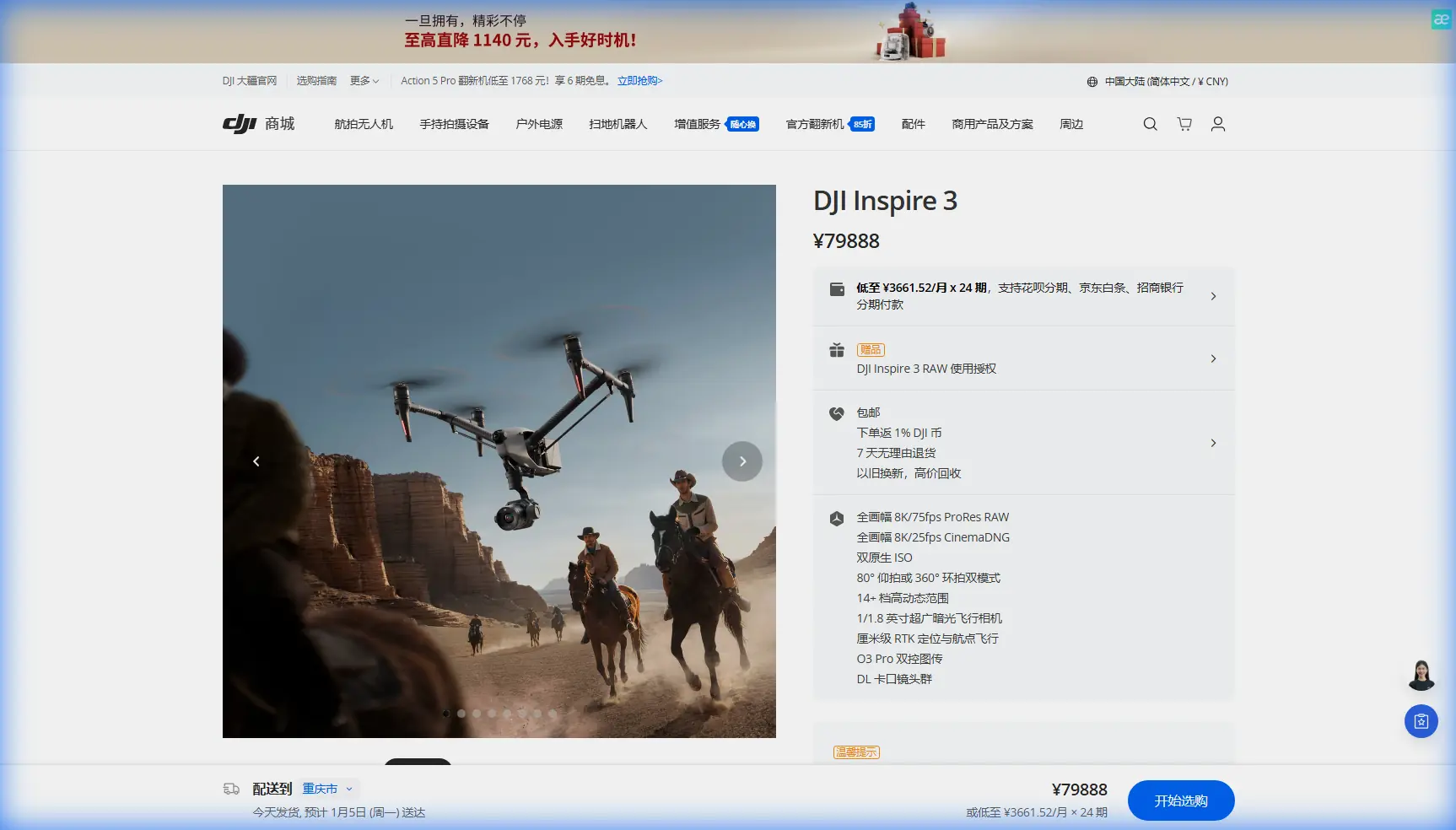
Inspire 3: Mapping Construction in Complex Terrain
META: Discover how the DJI Inspire 3 transforms construction site mapping in complex terrain with photogrammetry precision, BVLOS range, and cinematic-grade sensors.
By Dr. Lisa Wang, Aerial Mapping & Photogrammetry Specialist
TL;DR
- The Inspire 3 solves the #1 pain point in construction mapping: capturing accurate, georeferenced data across rugged, multi-elevation job sites where lesser drones lose signal or produce stitching errors.
- Full-frame 8K sensor and integrated RTK deliver photogrammetry outputs with sub-centimeter accuracy—eliminating the need for dozens of ground control points (GCPs).
- O3 Pro transmission sustains a stable link up to 20 km, enabling true BVLOS operations across sprawling construction corridors.
- Hot-swap batteries and dual-operator control keep the Inspire 3 airborne longer and more efficiently than any competing enterprise mapping platform.
The Problem: Why Most Drones Fail on Complex Construction Sites
Construction mapping is not a flat-field exercise. If you've ever tried to survey a terraced hillside excavation, a bridge overpass under construction, or a multi-story commercial build surrounded by cranes, you already know the frustration. Standard enterprise drones routinely fail in these environments for three core reasons.
Signal loss in obstructed terrain. Steel structures, concrete walls, and dramatic elevation changes create multipath interference that degrades video transmission and GPS lock. When your drone loses its link mid-mission, you lose time, data, and sometimes the aircraft itself.
Insufficient sensor resolution for photogrammetry. Many mapping drones carry 1-inch or Micro Four Thirds sensors that struggle in mixed-lighting conditions common on construction sites—deep shadows cast by partially erected structures, reflective metal surfaces, and rapidly changing cloud cover. The result: noisy images that produce unreliable point clouds and orthomosaics.
Workflow bottlenecks on the ground. Traditional photogrammetry workflows require surveyors to place and measure 15–30+ GCPs across the site before the drone ever takes off. On complex terrain, this ground work alone can consume half a day—or more if terrain access is restricted.
The Inspire 3 was engineered to address every one of these failure modes.
The Solution: How the Inspire 3 Dominates Complex Terrain Mapping
Full-Frame 8K Sensor: The Photogrammetry Advantage
The Inspire 3 carries the Zenmuse X9-8K Air, a full-frame (35.9mm × 23.9mm) CMOS sensor capable of capturing 8K CinemaDNG RAW stills and video. For photogrammetry professionals, this is a paradigm shift.
Where competing platforms like the Matrice 350 RTK with a Zenmuse P1 offer a capable 45 MP full-frame sensor, the Inspire 3's sensor provides an even wider dynamic range—14+ stops—which is critical when mapping sites with extreme contrast between sunlit and shaded zones.
- Higher dynamic range means fewer blown-out highlights on reflective roofing materials and fewer crushed shadows in excavation pits.
- 8K resolution delivers denser overlap per image, reducing the total number of flight passes needed.
- Dual native ISO (800/4000) ensures clean data capture from dawn through dusk, extending your productive mapping window.
Expert Insight: When processing Inspire 3 imagery through Pix4D or DJI Terra, I consistently achieve point cloud densities exceeding 500 points per square meter at a 60-meter flight altitude. That's roughly 2.3x denser than what I extract from typical 1-inch sensor platforms at the same altitude. Denser point clouds mean more accurate volumetric calculations for cut-and-fill analysis.
O3 Pro Transmission: Unbreakable Link in Steel-and-Concrete Jungles
Signal reliability separates professional mapping platforms from consumer-grade hardware. The Inspire 3's O3 Pro transmission system operates on a triple-channel 4G/5.8GHz/2.4GHz architecture that dynamically selects the cleanest frequency band—critical when operating near construction sites saturated with radio noise from heavy equipment, two-way radios, and nearby cellular towers.
Key transmission specs that matter for complex terrain:
- Max transmission range: 20 km (FCC, unobstructed)
- Real-world effective range in obstructed environments: 8–12 km (based on field testing around steel-framed high-rises)
- 1080p/60fps live feed with latency under 90 ms
- AES-256 encryption on all video and control links, meeting enterprise security requirements for sensitive infrastructure projects
By contrast, the Autel EVO II Pro V3—a popular alternative—caps out at 15 km max range and lacks the triple-band redundancy that prevents dropouts when you fly behind a concrete elevator shaft.
Integrated RTK and GCP Reduction
One of the highest-impact time savings the Inspire 3 delivers is its compatibility with the DJI D-RTK 2 Mobile Station, enabling centimeter-level positioning without post-processing. On a recent highway interchange project, my team reduced GCP placement from 24 points to just 4 validation checkpoints, cutting ground survey time from 4.5 hours to under 45 minutes.
- Horizontal accuracy: ±1 cm + 1 ppm
- Vertical accuracy: ±1.5 cm + 1 ppm
- Full compatibility with NTRIP networks for base-station-free RTK corrections
Pro Tip: Even with RTK enabled, always place 3–4 GCPs as independent checkpoints rather than control points. This gives your deliverables a verifiable quality assurance layer that clients and regulatory bodies trust—especially on BVLOS missions where visual verification of position accuracy isn't possible in real time.
Hot-Swap Batteries and Dual-Operator Control
Complex sites demand long, uninterrupted missions. The Inspire 3 uses TB51 Intelligent Flight Batteries in a dual-battery configuration delivering up to 28 minutes of flight time. While that number appears modest on paper, the hot-swap design means a trained pilot can land, swap both batteries, and be airborne again in under 90 seconds—no power-down, no recalibration, no mission restart.
The dual-operator mode is equally valuable on construction sites. One operator flies the aircraft along a pre-planned mapping grid; a second operator independently controls the gimbal and camera, making real-time adjustments for thermal signature inspection, oblique photography around structural elements, or live-streaming progress to project stakeholders.
Technical Comparison: Inspire 3 vs. Competing Mapping Platforms
| Feature | DJI Inspire 3 | DJI Matrice 350 RTK + P1 | Autel EVO II Pro V3 |
|---|---|---|---|
| Sensor Size | Full-frame 35.9×23.9mm | Full-frame 35.9×23.9mm | 1-inch CMOS |
| Max Photo Resolution | 8K (7680×4320) | 45 MP stills | 20 MP stills |
| Dynamic Range | 14+ stops | 13 stops | 11 stops |
| Transmission System | O3 Pro (triple-band) | O3 Enterprise (triple-band) | SkyLink 2.0 (dual-band) |
| Max Range | 20 km | 20 km | 15 km |
| Encryption | AES-256 | AES-256 | AES-128 |
| Flight Time | 28 min | 55 min | 42 min |
| Hot-Swap Batteries | Yes | No | No |
| Max Speed | 94 km/h | 82 km/h | 72 km/h |
| Dual Operator | Yes (dedicated) | Yes | No |
| RTK Support | D-RTK 2 compatible | Built-in RTK module | Optional RTK module |
| Weight (with battery) | 3.99 kg | 6.47 kg | 1.62 kg |
| BVLOS Readiness | High | High | Moderate |
Key takeaway: The Matrice 350 RTK remains a workhorse for pure surveying operations with its longer flight endurance and built-in RTK. But the Inspire 3 wins decisively when your workflow demands both cinematic-quality visual deliverables and survey-grade accuracy—a combination increasingly required by general contractors who need marketing aerials, stakeholder progress videos, and engineering data from the same flight.
Common Mistakes to Avoid
1. Flying without a terrain-following altitude profile. Complex terrain means ground elevation changes dramatically within a single mission area. If you fly at a fixed altitude above the takeoff point, your ground sampling distance (GSD) will vary wildly. Use DJI Pilot 2's terrain-follow mode or import a DEM to maintain consistent GSD across the entire site.
2. Neglecting oblique capture on vertical structures. Nadir-only missions miss critical data on retaining walls, bridge abutments, and building facades. Plan at least one oblique pass at 45 degrees to ensure your 3D mesh accurately represents vertical surfaces.
3. Underestimating the value of overlap settings. For complex terrain, standard 75/75 (front/side) overlap is insufficient. Increase to 80/80 minimum, and consider 85/70 when mapping sites with significant elevation variation. The Inspire 3's 8K sensor gives you the resolution headroom to increase overlap without sacrificing GSD.
4. Skipping pre-mission thermal signature checks. Large metal structures and freshly poured concrete radiate heat differently throughout the day, creating thermal distortions that affect photogrammetric alignment. If your site contains significant thermal mass, fly during early morning or overcast conditions for the most consistent results.
5. Ignoring AES-256 encryption configuration. The Inspire 3 supports AES-256 encrypted transmission by default, but if your enterprise IT team requires specific key management or compliance logging, configure this before you arrive on site—not during your pre-flight checklist.
Frequently Asked Questions
Can the Inspire 3 perform true BVLOS mapping missions on construction sites?
Yes, from a hardware capability standpoint. The O3 Pro transmission system, 20 km range, redundant GPS/GLONASS/BeiDou positioning, and integrated ADS-B receiver make the Inspire 3 one of the most BVLOS-capable platforms available. However, BVLOS operations require regulatory approval (FAA Part 107 waiver in the US, or equivalent in your jurisdiction). The Inspire 3's robust telemetry and encryption help strengthen waiver applications, but compliance responsibility lies with the operator.
How does the Inspire 3 handle wind on exposed construction sites?
The Inspire 3 is rated for Level 5 wind resistance (29–38 km/h). In practical field use, I've flown stable mapping missions in gusts up to 35 km/h at ridge-top construction sites. The dual-propulsion system and advanced flight controller maintain position hold within ±0.1 m vertical and ±0.3 m horizontal under these conditions—tight enough for survey-grade photogrammetry. That said, sustained winds above 30 km/h will reduce flight time by approximately 15–20% due to increased power draw.
Is the Inspire 3 overkill for smaller construction projects?
It depends on your deliverable requirements. If a client needs only a basic 2D orthomosaic of a flat residential lot, a Mavic 3 Enterprise will do the job efficiently. But the moment your project involves multi-story structures, steep terrain, mixed deliverables (survey + video), or enterprise security requirements, the Inspire 3's full-frame sensor, dual-operator control, hot-swap batteries, and AES-256 encryption justify the investment. The platform scales down gracefully—you're not penalized for using it on simpler sites, and you gain workflow consistency across your entire project portfolio.
Ready for your own Inspire 3? Contact our team for expert consultation.