
Inspire 3 for High-Altitude Wildlife Monitoring
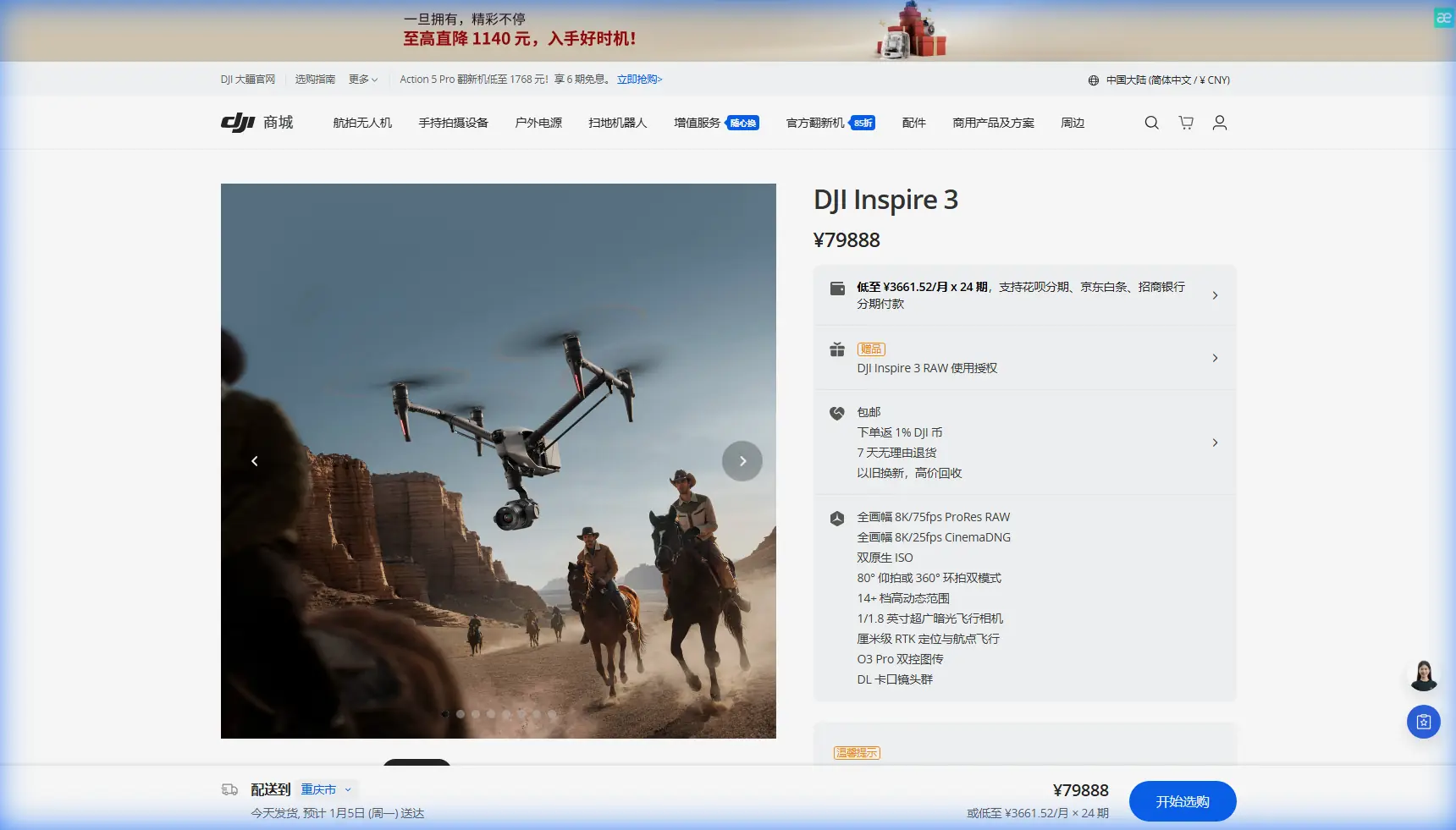
Inspire 3 for High-Altitude Wildlife Monitoring: What Actually Matters in the Field
META: Expert guide to using the DJI Inspire 3 for high-altitude wildlife monitoring, covering interference control, O3 transmission, AES-256 security, hot-swap batteries, thermal workflows, and photogrammetry planning.
High-altitude wildlife work exposes every weakness in an aerial platform. Thin air changes handling. Mountain ridgelines disrupt signal behavior. Fast weather shifts compress the decision window. Add the need to monitor sensitive species without repeated overflights, and the aircraft stops being a camera carrier and becomes part of a field science system.
That is where the Inspire 3 deserves a more careful discussion than it usually gets.
I approach this from the standpoint of operational reliability, not spec-sheet theater. If your assignment is monitoring wildlife in alpine or near-alpine terrain, the central question is not whether the aircraft can fly. It can. The question is whether it can produce defensible observations, maintain link integrity in awkward electromagnetic conditions, and sustain repeatable sorties when each launch site is logistically expensive to reach.
For that job, the Inspire 3 has a surprisingly strong case, provided you build the mission around its strengths and stop asking it to behave like a smaller, simpler drone.
The real problem at altitude
Wildlife monitoring in high terrain is rarely defeated by one dramatic failure. It usually degrades through a stack of smaller issues.
A survey team arrives at a ridge launch point. The visual line to the target valley looks clear, but the radio environment is not. Rock faces can create multipath reflections. Temporary field stations, vehicle radios, microwave backhaul equipment, and even nearby power infrastructure can introduce interference. At the same time, colder conditions affect battery behavior, while rapid elevation changes can force more aggressive climb and braking inputs than a lower-altitude mapping mission would.
Then the payload task itself complicates things. If you are documenting herd movement, nest area disturbance, den entrances, or migration corridors, you may need both broad-area scene context and precise repeatability. A thermal signature that looks obvious from one angle can blend into rock once the sun heats the slope. A photogrammetry pass that would be straightforward over flat ground becomes less forgiving when the terrain rises into the aircraft’s flight path.
This is why many high-altitude wildlife missions fail quietly. The aircraft comes back with footage, but the data is partial, inconsistent, or hard to compare across dates. In practical terms, that is often worse than an outright abort because it can create false confidence.
Why the Inspire 3 fits this mission profile
The Inspire 3 makes sense here for three operational reasons.
First, it is built for sustained professional flight operations rather than occasional opportunistic launches. That matters when your field day depends on multiple flights from a cold, exposed position.
Second, its O3 transmission system gives crews a more serious communication backbone than they get from many lighter systems. In mountains, link quality is not only about distance. It is about how the signal behaves when ridges, cliff bands, and irregular terrain start shaping the path. Strong transmission architecture does not eliminate that challenge, but it gives the crew more margin when the environment becomes less cooperative.
Third, the platform’s security posture, including AES-256 transmission encryption, matters more than many conservation teams initially realize. Wildlife monitoring often intersects with sensitive location data. Nesting sites, rare species concentrations, and protected habitat boundaries should not be treated casually. Encryption is not just an IT checkbox. It reduces exposure when teams are working around research partners, government agencies, or private land arrangements that require stricter control of imagery and telemetry.
Those are not abstract benefits. They affect whether the mission can be repeated, trusted, and shared appropriately.
Interference is the hidden high-altitude threat
One of the most overlooked field skills in mountain operations is antenna discipline.
Crews often blame the aircraft when the real issue is controller orientation. In a high-altitude wildlife mission, the launch point may sit above the target area, which changes the instinctive way operators hold the controller. Instead of facing a subject on roughly the same plane, you may be transmitting down into a basin or across a slope. If the antennas are poorly aligned, the link can weaken even when the aircraft appears close and unobstructed.
With the Inspire 3, careful antenna adjustment should be treated as part of the pre-flight procedure, not a reaction to warning messages. The operator should assess where the aircraft will actually spend most of the mission, then orient the controller for that geometry rather than for the takeoff moment. If the route bends around a shoulder of terrain, the team should anticipate the likely weak zone before launch.
Electromagnetic interference adds another layer. In some field sites, the noise source is obvious. In others, it is subtle: a relay station a few kilometers away, a vehicle-mounted comms unit, or camp equipment running nearby. The practical response is disciplined and simple. Separate the pilot position from unnecessary electronics when possible. Recheck antenna angle after changing stance or body position. If signal quality dips, do not immediately push farther and hope the system sorts itself out. Pause, climb if terrain allows, and restore stronger geometry.
This matters because O3 transmission is excellent, but no transmission system is exempt from bad assumptions. A strong link architecture gives you resilience. It does not replace fieldcraft.
Thermal work at altitude requires timing, not just hardware
People often talk about wildlife thermal detection as if it were a matter of having the right camera and opening the app. That is not how experienced teams operate.
A thermal signature is only useful when it is distinct from the background. In high-altitude environments, background conditions can shift fast. Early morning may provide clean separation between animals and cold ground. By late morning, solar loading on exposed rock can reduce contrast dramatically. Wind can also alter the surface temperature pattern enough to complicate interpretation.
This is where the Inspire 3 becomes valuable as a stable mission platform rather than just an observation tool. If you can hold consistent routes, altitudes, and timing windows across repeated flights, your thermal observations become far more comparable. That consistency is what turns airborne scouting into monitoring.
For species disturbance management, that distinction is crucial. You want fewer passes, better planned. A single well-timed thermal sweep across a basin edge can be more useful than multiple improvised flights that push animals unnecessarily.
Photogrammetry is not just for mapping terrain
In wildlife work, photogrammetry is often treated as secondary to live observation. That is a mistake, especially at elevation.
If you are monitoring habitat change, snowline retreat near movement corridors, erosion around nesting zones, or vegetation shifts near water access, photogrammetry provides the spatial context that raw video cannot. The Inspire 3 can support that kind of structured capture when the mission is planned correctly.
The challenge in mountains is control. Terrain variation increases the need for careful overlap, altitude management, and reference quality. This is where GCP deployment becomes operationally significant. Ground control points are not glamorous, but they are often the difference between a visually impressive model and one that can support real comparison across survey dates.
In steep country, a few well-placed GCPs can anchor your reconstruction and reduce ambiguity in areas where slope and shadow make alignment less forgiving. If your team is tracking habitat disturbance boundaries or comparing den approach routes over time, that extra positional reliability matters. It can determine whether an observed change is real or just a reconstruction artifact.
The Inspire 3’s role here is not magical. It simply provides a more robust flight platform for a disciplined data-acquisition method. That is enough.
The battery question is bigger than endurance
High-altitude teams talk a lot about flight time, but endurance alone is not the decisive metric. Turnaround is often more important.
A wildlife crew may have a narrow weather opening, a short low-wind period, or a brief interval when animal activity is expected in a specific zone. In those moments, hot-swap batteries are not a convenience feature. They are part of mission continuity.
The ability to exchange power quickly without rebuilding the whole launch sequence helps preserve momentum, crew focus, and environmental awareness. It also reduces the tendency to stretch a flight too long just to avoid downtime. That kind of decision-making drift is common in field operations and often goes unspoken.
At elevation, battery management also needs to be more deliberate. Packs should be temperature-managed before flight, and crews should avoid interpreting nominal battery percentage as a complete picture of remaining margin. Cold conditions and altitude-related workload can produce a harsher energy profile than a lowland training mission. Fast swaps help, but only if they are paired with conservative mission design.
Security and chain-of-custody are not side issues
Conservation, wildlife law enforcement, and ecological monitoring increasingly overlap with sensitive data handling. An aircraft that transmits securely using AES-256 gives field teams a better baseline when they are collecting location-linked material that should not circulate freely.
That includes footage of protected nesting sites, migration bottlenecks, anti-poaching patrol patterns, or temporary animal concentrations. Too many teams think about drone security only after an external reporting requirement appears. By then, the workflow is already messy.
Using a system with strong encrypted transmission helps create a cleaner chain-of-custody from collection onward. If you coordinate operations with researchers or reserve managers and need a quick planning channel, I usually recommend setting up a field communication thread before deployment, such as a direct mission briefing chat, so flight notes, observation windows, and interference concerns are captured alongside the sortie plan.
The point is not bureaucracy. It is preserving trust in the data and protecting the species you are there to monitor.
What about BVLOS?
BVLOS is frequently mentioned in mountain operations because the terrain can tempt teams into thinking they need it immediately. Sometimes they do. Often they just need better site selection and route design.
The Inspire 3 sits in a class of aircraft that invites ambitious mission planning, but wildlife monitoring should stay anchored to the legal and operational framework of the region. If a mission truly requires BVLOS to maintain safe and effective coverage, that should be handled as a formal operational question, not as an improvised extension of a visual-line sortie.
Still, the fact that crews even ask the BVLOS question tells you something useful: the platform has enough capability that the operational boundary quickly becomes regulatory and procedural rather than purely technical. That is not trivial. It means the aircraft can support more advanced conservation workflows when the organization around it is mature enough.
A practical field workflow for the Inspire 3
For high-altitude wildlife monitoring, I recommend a problem-solution workflow rather than a generic flight checklist.
The problem is uncertainty: signal uncertainty, weather uncertainty, terrain uncertainty, and animal behavior uncertainty.
The solution is to reduce variability wherever the crew still has control.
Start with the launch point. Choose it for radio geometry as much as visual convenience. Then define a primary observation route and a fallback route in case a ridgeline or interference pocket degrades the link. Before takeoff, orient the controller antennas based on the intended working sector, not just the position of the aircraft on the ground.
Next, split the mission objective clearly. If the flight is for thermal detection, time it for background contrast. If it is for photogrammetry, build for overlap and GCP support rather than trying to “grab some mapping while we are there.” Mixing objectives carelessly is how teams return with neither strong imagery nor strong models.
Then plan battery turnover as part of the mission itself. Hot-swap capability helps only when the crew already knows which segment comes next, what data still needs to be captured, and what environmental threshold would trigger an abort.
Finally, document the radio environment. If interference appears near a certain slope aspect, launch site, or equipment cluster, write it down. On future missions, that note can be as valuable as any camera setting.
The bottom line
The Inspire 3 is not interesting for high-altitude wildlife monitoring because it is new or because it carries a premium reputation. It is interesting because several specific capabilities line up unusually well with the realities of hard fieldwork.
O3 transmission improves operational margin when terrain and interference complicate the link. AES-256 encryption helps protect sensitive wildlife data in a way many teams underestimate until it matters. Hot-swap batteries support continuity during short environmental windows. And when paired with disciplined timing, antenna handling, GCP-supported photogrammetry, and realistic route planning, the aircraft can produce monitoring data that is not only visually strong but operationally dependable.
That is the standard that matters in mountain conservation work. Not whether the drone flew, but whether the mission holds up when the landscape stops cooperating.
Ready for your own Inspire 3? Contact our team for expert consultation.