
Expert Scouting with Inspire 3: Why Reliability Matters
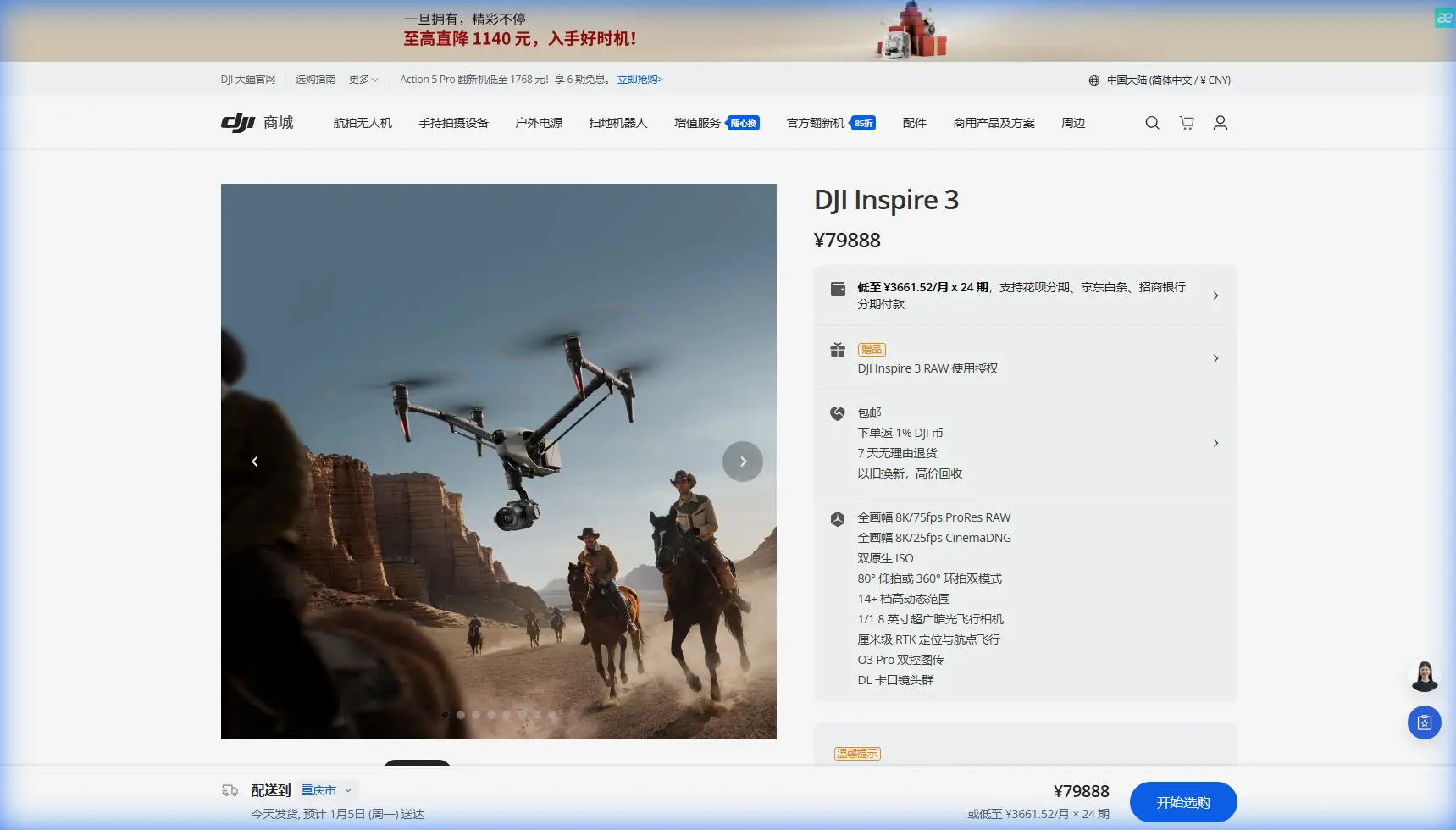
Expert Scouting with Inspire 3: Why Reliability Matters More Than Spec Sheets on Mountain Coastlines
META: A field-driven look at why Inspire 3 stands out for coastal mountain scouting, with practical insights on endurance, transmission stability, thermal workflow, and the hidden engineering logic behind dependable aerial operations.
Scouting a coastline in mountainous terrain sounds cinematic until you are the one planning the sortie.
Cliffs disrupt signal paths. Salt air punishes hardware. Wind funnels through ridgelines, then drops into deceptive calm over coves. Lighting changes by the minute. If the mission includes terrain modeling, thermal signature review, or repeated passes for photogrammetry, the aircraft cannot simply be “good on paper.” It has to stay consistent when the environment gets complicated.
That is where the Inspire 3 earns its reputation.
A lot of aircraft can produce attractive footage in easy conditions. Far fewer can support serious coastal scouting work where the operator needs stable transmission, repeatable path accuracy, fast turnaround between flights, and confidence that the platform will not become the weak link halfway through a survey window. For mountain shoreline work, that difference is everything.
The real problem with coastal mountain scouting
The challenge is not just distance. It is interference, geometry, and fatigue.
A coastal scouting team may need to document erosion zones, inspect hard-to-reach cliff edges, build a photogrammetry dataset for terrain reconstruction, and capture thermal signature information around infrastructure or environmental anomalies. In that setting, every interruption compounds. A dropped feed means a missed anomaly. A battery change that takes too long can lose the light angle needed for mapping. A platform that drifts from repeatable flight lines creates headaches when stitching models or validating GCP alignment later.
This is why professionals stop talking about isolated features and start looking at systems.
The Inspire 3 makes sense here because it behaves like a mission tool, not just a camera drone.
Reliability begins long before takeoff
There is a useful lesson buried in traditional aircraft engineering standards, and it applies surprisingly well to how serious operators should evaluate a platform like Inspire 3.
One reference standard for aircraft hose assemblies requires 4 hose assemblies to be tested in sequence for extension and contraction, stress reduction, conductivity, and density checks. Another passage allows sampling from every 5000 ft of hose produced. That may seem far removed from drones, but the operational significance is direct: in aviation-grade thinking, reliability is not assumed from design intent alone. It is proven through repeated stress, material behavior, and batch discipline.
That mindset matters when choosing an aircraft for coastal mountain scouting.
You are not just buying flight performance. You are selecting a system that must tolerate repeated deployment, environmental exposure, and operational strain without introducing uncertainty into the mission. Inspire 3 stands out because it feels designed for operators who understand that dependability is not a marketing phrase. It is what lets you finish the route, recover clean data, and launch again before weather closes in.
Why Inspire 3 fits the coastline-and-mountain use case better than lighter competitors
Smaller aircraft often win attention because they are easier to carry and quicker to unfold. In flat, simple locations, that can be enough. On a mountain coastline, it often is not.
The Inspire 3’s advantage is not merely that it is more capable. It is that its capability is better matched to professional scouting demands.
Transmission is a prime example. In ridgeline environments, direct line of sight can disappear in seconds as the aircraft works around rock faces or elevation changes. A platform with robust O3 transmission gives the crew more confidence when monitoring framing, terrain clearance, and thermal or visual detail in real time. That is not an abstract convenience. It affects whether the team can maintain mission tempo without constantly re-positioning the ground station.
The same goes for secure operations. For infrastructure stakeholders, environmental survey firms, and industrial inspection teams, data handling is not trivial. AES-256 support matters because scouting missions often involve sensitive location imagery, site conditions, or preliminary survey intelligence. A secure transmission environment reduces friction when working with clients who care about data governance as much as image quality.
This is one of the quiet ways Inspire 3 moves ahead of consumer-leaning alternatives. It supports serious fieldwork without making the operator improvise around professional requirements.
Battery workflow is not a convenience feature in the mountains
On a coast bordered by steep terrain, the weather window can be brutally narrow.
You may get thirty useful minutes of stable light before cloud cover rolls in from offshore. You may need one pass for visual capture, another for thermal signature comparison, and a third for overlap insurance in a photogrammetry run. Walking back to a staging point, shutting down fully, and rebuilding momentum wastes the very thing you cannot recover: field time.
That is why hot-swap batteries matter so much on Inspire 3.
People often discuss battery systems as though they are mainly about flight duration. In professional scouting, turnaround time is just as important. A hot-swap workflow lets crews keep the aircraft operationally ready between sorties, reducing dead time and preserving continuity in mission planning. If the light, tide, or thermal conditions are evolving, that continuity can be the difference between a clean dataset and a compromised one.
Competitor aircraft with less efficient swap routines may still finish the day. Inspire 3 is better at helping you capitalize on the exact moment the site is most readable.
Precision work: photogrammetry, terrain reconstruction, and repeatability
Mountain coastlines are visually dramatic, but they are hard on mapping workflows.
Sharp elevation changes create occlusion. Uneven surfaces can trick overlap planning. Reflective water near rock faces complicates exposure and texture consistency. If the mission includes photogrammetry, the aircraft needs more than a good camera. It needs to fly consistently enough that the data can be trusted when processed.
This is where Inspire 3 earns a second look from teams who normally separate “cinema drones” from “survey drones.” In the field, that distinction is often too simplistic. A high-end aerial platform that can hold precise routes, capture stable imagery, and return for repeated passes under changing conditions becomes valuable for terrain analysis, visual documentation, and stakeholder reporting.
Add GCP-based workflows, and the platform’s consistency becomes even more important. Ground control points only improve the final model if the captured imagery remains coherent across the flight set. Unstable acquisition forces extra cleanup and can undermine confidence in measurements near cliffs, road cuts, or shoreline infrastructure.
For firms doing coastal assessment, pre-construction scouting, or environmental monitoring, Inspire 3 can serve as more than a visual storytelling platform. It becomes a serious data collection asset.
Thermal signature work changes how you scout
Visual imagery shows form. Thermal signature data often reveals function.
On a mountain coast, that can mean identifying moisture patterns in slopes, spotting heat anomalies around facilities, locating drainage behavior, or separating material differences that are easy to miss in standard RGB imagery. The point is not that thermal replaces visual capture. The point is that it changes the operator’s understanding of the site.
Inspire 3 becomes especially compelling when the mission requires repeated, stable runs and high-confidence positioning around difficult terrain. Thermal interpretation is only useful if the aircraft can hold a reliable path and maintain a clean live view during the pass. This circles back to transmission quality, battery continuity, and operator confidence under real field conditions.
A drone that jitters through the mission plan or forces rushed decisions because of weak link stability will always produce poorer scouting outcomes, no matter how strong the thermal payload appears on paper.
The hidden engineering lesson: maintenance matters because wear is real
Another aircraft design reference highlights why modern aircraft favor self-lubricating bearings over non-self-lubricating types. The reason is practical: conventional bearings may require regular maintenance, lubricant paths can clog, and grease can be forced out under high load, accelerating wear. The text also notes a tradeoff inside self-lubricating designs. TFE-lined bearings are widely used and mature, but the lining is softer and can wear, causing clearance to increase over time. By contrast, MoS2 dry-film solutions offer high surface hardness and low wear, but are best suited to very small oscillating motion, noted as less than 1 degree.
Why bring that up in an Inspire 3 article?
Because it captures the operational truth that professionals already know: endurance in the field depends on how a system handles wear, friction, and repeated movement over time. Not every capable machine stays precise after sustained use. In coastal mountain scouting, where setups are repeated, transported, redeployed, and exposed to environmental stress, long-term mechanical discipline matters.
The Inspire 3 feels closer to that aviation mindset than many alternatives. It is built for crews who value repeatable performance over novelty. That does not mean it is indestructible. It means it is aligned with professional expectations: stable operation, efficient redeployment, and fewer compromises when missions stack up back-to-back.
BVLOS planning starts with trust in the platform
Any discussion of BVLOS in civilian operations should stay grounded in local regulations, approvals, and risk management. But even in planning terms, the principle is clear: operations that move farther from the pilot demand more confidence in aircraft behavior, transmission integrity, and system predictability.
That is another reason Inspire 3 deserves attention for advanced scouting programs.
Even if the mission remains fully within legal visual constraints, the same qualities that support BVLOS-style planning discipline are useful in ordinary field operations: clear situational awareness, resilient connectivity, secure communications, and efficient battery handling. These are not luxury features. They are the scaffolding that allows teams to run organized, low-friction missions in difficult terrain.
Where Inspire 3 clearly excels
Against lighter and more convenience-oriented competitors, Inspire 3 stands out in one crucial way: it reduces operational compromise.
Not every crew needs that. If the job is a quick social clip above an accessible beach, almost any decent aircraft can do it. But mountain coastline scouting is rarely that forgiving. You may be working from a narrow launch point with changing wind vectors and partial signal obstruction. You may need multiple flight profiles in a single session. You may have one chance to document a site before conditions change.
That is where Inspire 3 separates itself.
It brings together robust transmission, secure workflow support, fast battery turnover, and the sort of repeatable flight behavior that serious operators appreciate only after they have lost time to less capable systems. It does not win because one isolated specification is bigger. It wins because the platform is less likely to disrupt the mission.
A smarter way to evaluate it for your operation
If you are assessing Inspire 3 for coastline scouting in mountainous areas, do not start with cinematic output alone. Start with field questions:
- Can the aircraft maintain a dependable link when terrain breaks line of sight?
- Can your team swap power fast enough to preserve changing environmental conditions?
- Can the mission produce repeatable data for photogrammetry and GCP-supported modeling?
- Can the workflow support secure handling of site imagery?
- Can the platform keep performing after repeated deployment cycles in harsh coastal conditions?
Those are better questions than “How good is the camera?” because they reveal whether the aircraft will still be working for you after the easy part of the demo is over.
If you want to discuss how Inspire 3 fits coastal scouting, terrain modeling, or thermal workflows, you can message a field specialist directly.
The most capable drone for this kind of work is not the one with the flashiest headline feature. It is the one that keeps your mission intact when geography, weather, and time all start pushing in the opposite direction. On that measure, Inspire 3 is exceptionally strong.
Ready for your own Inspire 3? Contact our team for expert consultation.