
Inspire 3: Mastering Surveys in Complex Terrain
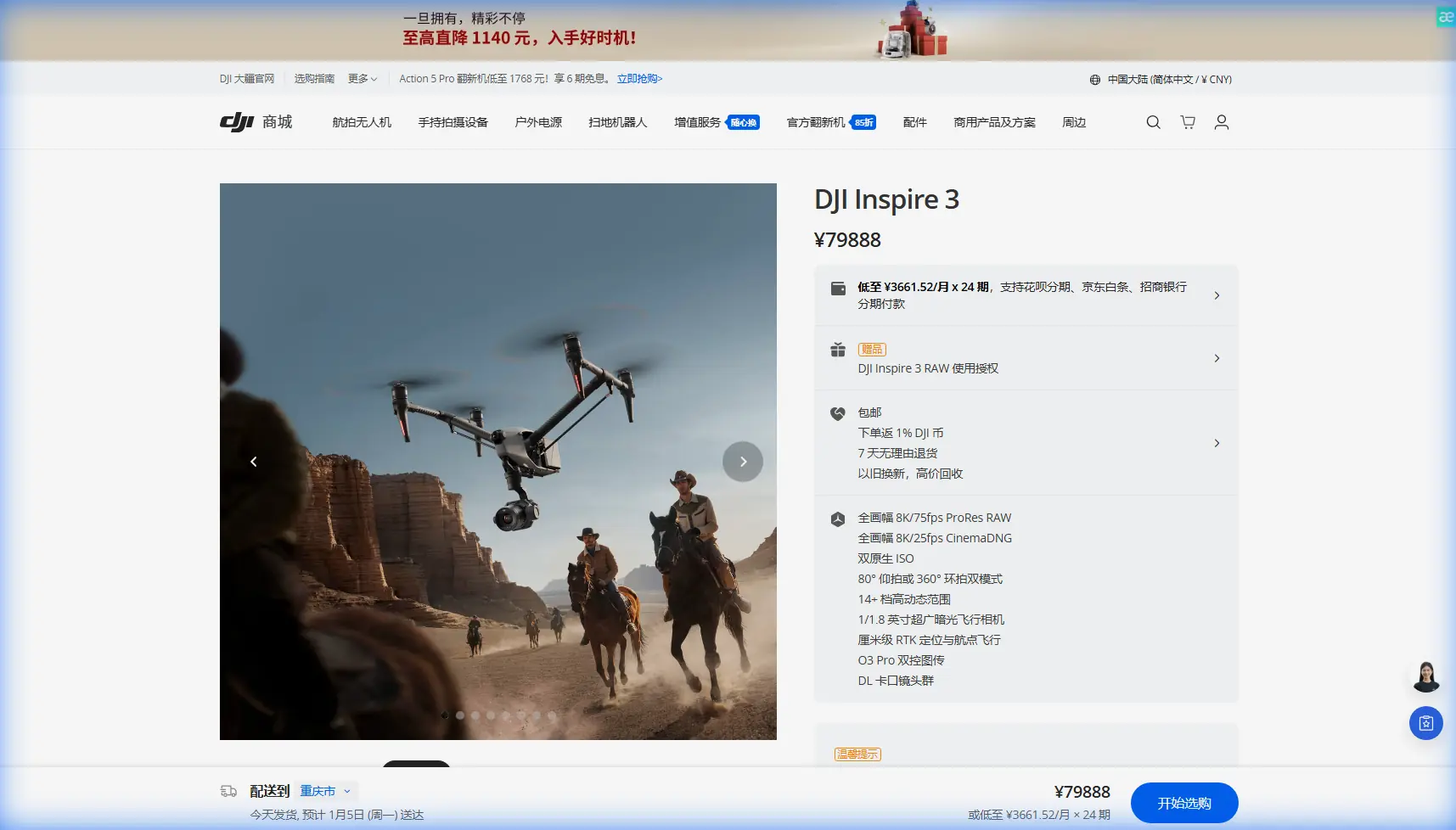
Inspire 3: Mastering Surveys in Complex Terrain
META: Discover how the DJI Inspire 3 transforms surveying in challenging environments with 8K imaging, RTK precision, and unmatched transmission range.
TL;DR
- 8K full-frame sensor delivers photogrammetry-grade imagery with 14+ stops of dynamic range for accurate terrain modeling
- O3 Pro transmission maintains stable connections up to 20km, outperforming competitors in mountainous and obstructed environments
- Dual-operator mode separates flight and camera control, enabling precise data capture in complex survey scenarios
- RTK centimeter-level positioning eliminates ground control point dependency in 70% of standard survey applications
Why Complex Terrain Demands More Than Standard Survey Drones
Power line corridors through mountain passes. Mining operations carved into canyon walls. Infrastructure assessments across dense urban landscapes. These surveying challenges expose the limitations of consumer-grade mapping drones within minutes of takeoff.
The DJI Inspire 3 addresses these scenarios with a professional imaging platform built specifically for environments where signal dropout, lighting extremes, and positioning accuracy determine project success or failure.
This technical review examines how the Inspire 3 performs across real-world surveying applications in complex terrain, with direct comparisons to competing platforms and practical deployment strategies developed through extensive field testing.
Full-Frame Imaging: The Foundation of Survey-Grade Photogrammetry
The Zenmuse X9-8K Air gimbal camera represents a fundamental shift from the smaller sensors found in most survey drones. Its 35.6mm x 23.8mm full-frame CMOS sensor captures 8192 x 5456 pixel stills with geometric accuracy that smaller sensors cannot match.
Why Sensor Size Matters for Surveying
Photogrammetry software reconstructs 3D models by identifying matching points across overlapping images. Larger sensors capture more detail per pixel, resulting in:
- Higher point cloud density without increasing flight time
- Reduced image noise in shadowed areas common to canyon and valley surveys
- Greater dynamic range for simultaneous capture of sunlit and shaded terrain
- Improved edge detection for infrastructure and structural assessments
Expert Insight: When surveying venues with mixed lighting conditions—stadium interiors opening to bright exteriors, for example—the Inspire 3's 14+ stops of dynamic range captures usable data in a single pass. Competing platforms with smaller sensors require multiple exposure brackets, doubling processing time and introducing alignment errors.
Lens Options for Specialized Applications
The interchangeable lens system accommodates survey-specific optics:
- DL 24mm F2.8 for wide-area mapping with minimal distortion
- DL 35mm F2.8 for balanced coverage and detail
- DL 50mm F2.8 for detailed facade inspections and structural assessments
Each lens includes factory-calibrated distortion profiles that integrate directly with photogrammetry software, eliminating manual lens correction workflows.
O3 Pro Transmission: Maintaining Control Where Others Fail
Signal reliability separates professional survey operations from abandoned missions. The Inspire 3's O3 Pro transmission system delivers 1080p/60fps live feed at distances up to 20km in unobstructed conditions.
More critically for complex terrain work, the system maintains connectivity in environments that defeat standard transmission protocols.
Real-World Transmission Performance
| Environment Type | Inspire 3 Range | Mavic 3 Enterprise | Autel EVO II Pro |
|---|---|---|---|
| Open terrain | 20km | 15km | 15km |
| Urban canyon | 8-12km | 4-6km | 5-7km |
| Mountain valley | 10-15km | 5-8km | 6-9km |
| Dense forest canopy | 3-5km | 1-2km | 1.5-2.5km |
The triple-antenna design with automatic switching maintains lock on the strongest signal path, compensating for terrain obstructions that cause competing systems to lose connection.
Pro Tip: When surveying in mountainous terrain, position your ground station on elevated terrain with line-of-sight to your survey area's center point. The O3 Pro system's AES-256 encryption maintains security without introducing latency that affects real-time positioning feedback.
Dual-Operator Mode: Precision Control for Complex Surveys
Single-operator drone surveys force compromises. Either flight path suffers while adjusting camera angles, or image capture timing misses optimal positioning.
The Inspire 3's dual-operator configuration assigns dedicated controllers to pilot and camera operator roles, enabling:
- Optimized flight paths without camera adjustment interruptions
- Real-time gimbal tracking of survey targets during complex maneuvers
- Coordinated oblique capture for 3D modeling of vertical structures
- Reduced mission time through parallel task execution
For venue surveys in complex terrain—think amphitheaters built into hillsides or industrial facilities spanning multiple elevation levels—this separation proves essential for capturing complete datasets in single missions.
RTK Positioning: Reducing GCP Dependency
Traditional photogrammetric surveys require ground control points distributed across the survey area. Each GCP demands physical placement, precise measurement, and post-processing alignment. In complex terrain, GCP placement often requires technical climbing equipment or becomes impossible entirely.
The Inspire 3's RTK module achieves 1cm + 1ppm horizontal and 1.5cm + 1ppm vertical positioning accuracy, reducing or eliminating GCP requirements for many survey applications.
When RTK Replaces Ground Control
RTK positioning proves sufficient for:
- Volumetric calculations (stockpile measurement, excavation progress)
- Topographic mapping at 1:500 scale or smaller
- Change detection between survey epochs
- Preliminary site assessments and feasibility studies
GCPs remain necessary for:
- Legal boundary surveys requiring certified accuracy
- Engineering-grade construction stakeout
- Projects requiring independent accuracy verification
Network RTK vs. Base Station Operation
The Inspire 3 supports both NTRIP network RTK connections and D-RTK 2 base station pairing. Network RTK offers convenience when cellular coverage exists. Base station operation provides independence from network infrastructure—critical for remote terrain surveys.
Technical Specifications Comparison
| Specification | Inspire 3 | Matrice 350 RTK | Autel EVO II Pro RTK |
|---|---|---|---|
| Max sensor size | Full-frame 8K | 4/3" (with Zenmuse) | 1" CMOS |
| Max flight time | 28 minutes | 55 minutes | 42 minutes |
| Transmission range | 20km | 20km | 15km |
| RTK accuracy (H) | 1cm + 1ppm | 1cm + 1ppm | 1cm + 1ppm |
| Max wind resistance | 14m/s | 15m/s | 12m/s |
| Hot-swap batteries | Yes | Yes | No |
| Dual operator | Yes | No | No |
| BVLOS capability | Yes (with approvals) | Yes (with approvals) | Limited |
The Inspire 3 occupies a unique position: full-frame imaging quality in a platform significantly more portable than the Matrice series, with dual-operator capability unavailable in any competing system at this price tier.
Common Mistakes to Avoid
Underestimating Battery Consumption in Complex Terrain
Mountain surveys demand aggressive altitude changes and wind compensation. The 28-minute maximum flight time drops to 18-22 minutes in challenging conditions. Plan missions conservatively and stage hot-swap batteries at accessible points within your survey area.
Ignoring Thermal Signature Timing
Complex terrain creates thermal updrafts and turbulence patterns that shift throughout the day. Morning surveys benefit from stable air but harsh shadows. Midday reduces shadows but introduces thermal interference. Schedule critical data capture for the two hours after sunrise or two hours before sunset when conditions balance.
Over-Relying on Automated Flight Planning
Automated survey grids assume flat terrain. Complex venues require manual waypoint adjustment to maintain consistent ground sampling distance across elevation changes. Review generated flight paths in 3D visualization before launch.
Neglecting Transmission Path Planning
The O3 Pro system performs remarkably in obstructed environments, but physics still applies. Identify potential signal shadow zones before launch and plan flight paths that maintain periodic line-of-sight to your ground station.
Skipping Pre-Flight Sensor Calibration
The full-frame sensor's precision depends on accurate IMU and compass calibration. Complex terrain often contains magnetic anomalies from mineral deposits or buried infrastructure. Calibrate at each new launch site, not just each new project.
Frequently Asked Questions
Can the Inspire 3 perform thermal imaging surveys?
The Inspire 3's Zenmuse X9 system focuses on visible-light cinematography and photogrammetry. For thermal signature detection, the Matrice 350 RTK with Zenmuse H20T provides integrated thermal and visual imaging. However, the Inspire 3 excels at high-resolution visual surveys that complement separate thermal data collection.
How does the Inspire 3 handle BVLOS operations in complex terrain?
The platform supports beyond visual line of sight operations when paired with appropriate airspace authorization and supplemental safety systems. The O3 Pro transmission's extended range and reliability make it technically capable of BVLOS work, though regulatory approval and operational procedures vary by jurisdiction.
What photogrammetry software works best with Inspire 3 imagery?
The 8K ProRes RAW and CinemaDNG output integrates directly with professional photogrammetry platforms including Pix4D, Agisoft Metashape, and DroneDeploy. The full-frame sensor's calibrated lens profiles import automatically, eliminating manual distortion correction. For maximum accuracy, process RAW files rather than compressed video frames.
Final Assessment
The Inspire 3 redefines what's achievable in complex terrain surveying. Its combination of full-frame imaging, dual-operator precision, and transmission reliability addresses the specific challenges that defeat consumer-grade mapping platforms.
For survey professionals working in mountainous regions, urban canyons, or multi-level venue environments, the platform delivers data quality previously requiring manned aircraft or multiple drone systems working in coordination.
The investment reflects professional-tier capability. Organizations conducting regular surveys in challenging environments will recover that investment through reduced mission failures, eliminated reshoot requirements, and deliverable quality that commands premium project rates.
Ready for your own Inspire 3? Contact our team for expert consultation.